From annotation to FASTA in seconds
FAS2rDNA converts genomic coordinates into multi-FASTA sequences — automatically, across 27 assemblies, at any scale. No manual database queries. No formatting overhead.
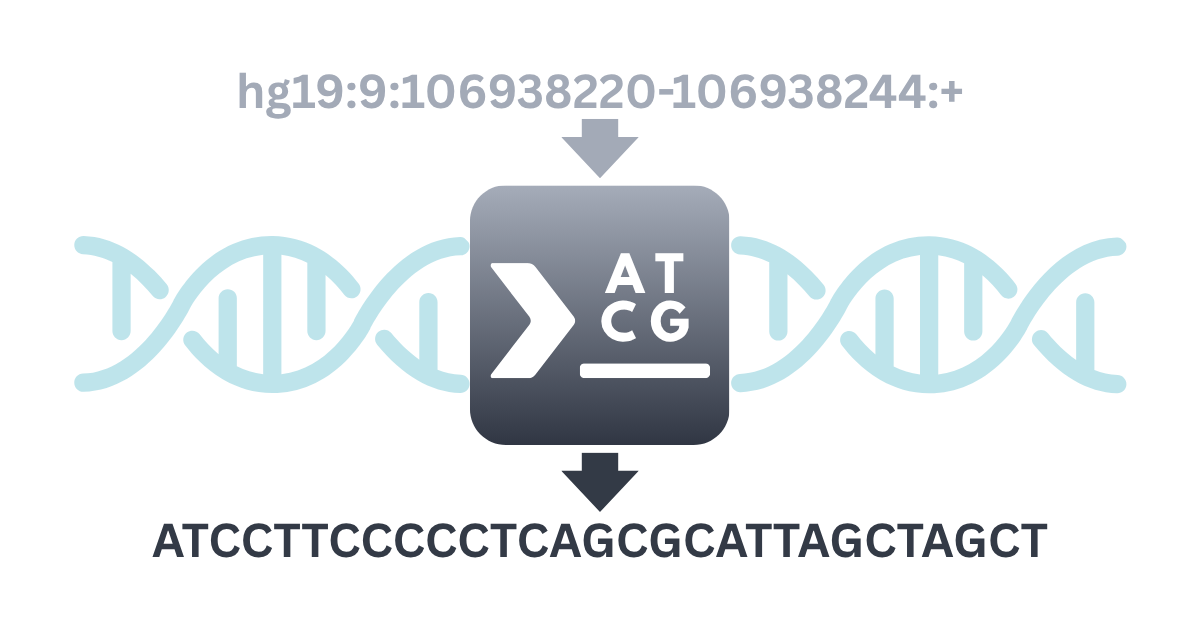
FAS2rDNA pipeline framework
What FAS2rDNA does
FAS2rDNA simplifies extraction and reconstruction of DNA sequences by transforming tabulated input data into reconstructed multi-FASTA outputs. Given genomic coordinates, it automatically retrieves reference genomes and reconstructs corresponding DNA sequences in a reproducible, deterministic manner.
Modern genomics is no longer limited by data generation — but by how efficiently genomic information is transformed into machine-usable representations. FAS2rDNA bridges coordinate-based genomic data and sequence-level analysis.
Read the protocolBatch & multi-region
Process thousands of genomic regions across multiple assemblies in a single run. No per-entry manual lookup.
Assembly-aware
Automatically detects assemblies from your seq_loc column. Supports 27 assemblies across 7 species.
Strand-aware reconstruction
Correctly handles positive and negative strand sequences with complement and reverse operations.
Learn how to easily run your first FAS2rDNA experiment.
Three ways to use FAS2rDNA
CLI
High-performance, production-scale workflows. For local machines, servers, and HPC environments.
View on GitHubColab
Runs entirely in the browser via Google Colab. No local setup. Ideal for demos and exploratory analysis.
Open ColabWeb — New
Register for free. Upload your TSV, configure your run, and download results — no install needed.
Get started freePublications
FAS2rDNA-Colab: A cloud-based workflow for pan-cancer, isoform-wide miRNome reconstitution across TCGA cohorts. (2025). Protocols.io
DOI: 10.17504/protocols.io.14egn1xr6v5d/v1High-throughput isoform-wide miRNome sequence reconstruction in the TCGA-LUAD cohort using FAS2rDNA. (2025). Protocols.io
DOI: 10.17504/protocols.io.rm7vzenqxvx1/v1Ready to reconstruct your sequences?
Free tier included. No credit card required. Results ready in minutes.
Create free account